Video and Sound Production/ Bachelor of Design (Honours) in Creative Media / Taylor's University
Task 1 - Exercise
TABLE OF CONTENTS
1.Instructions
2.Lecture
3.Task
4.Feedback
5.Reflection
Instructions
Lecture
week1
In the first week, Mr. Martin introduced us to what we were studying this semester and asked us to introduce ourselves. In the first week's task, we combined the disorganized video clips into a complete video. , we need to piece together a complete video through the character's next actions and language. This is also the best way for us to get a preliminary understanding of PR software. We practiced one video in class, and we will complete another video after class
Week 1 asynchronous class Quiz result:
Week 2
Different lens sizes correspond to different composition positions of the human body.
Fig. 1.1 Types of camera shots by size Week 2 (29/04/2024)
Fig. 1.2 Types of camera shot size Week 2 (29/04/2024)
An extreme long shot (or extreme wide shot), the landscape is large but the subject is relatively small.
The wide shot allows for beautiful background images as well as onlookers, which will make any momentous moment feel more cinematic.
Full Shot (FS) A camera shot in which the subject fills the entire frame while emphasizing the landscape.
A medium long shot (aka medium long shot) frames the subject from roughly the knees up.
A variation on this is the Cowboy Shot, which frames the subject from roughly mid-thighs up.
The medium shot is one of the most common camera shots. The viewing area is roughly from the waist up and across the torso.
The medium close-up frames your subject from roughly the chest up. So it typically favors the face, but still keeps the subject somewhat distant.
An extreme close-up is the largest close-up you can take to fill the frame with your subject. It often shows eyes, mouth, and trigger. In extreme close-ups, smaller objects gain rich detail and come into focus.
An establishing shot is a shot at the beginning of a scene that clearly shows us where the action is. This shot is usually followed by an aerial shot to show where everything will take place.
Fig. 1.3 Types of camera shot framing Week 2 (29/04/2024)
When your camera captures a subject, it's called a one-shot, and only one character is in the frame.
A two-shot is a camera shot with two characters featured in the frame.
A three-shot features three characters in the frame.
An over-the-shoulder shot shows your subject from behind another character's shoulder. Because it simulates perspective, it's common in conversation scenes.
An over-the-hip shot is similar to an over-the-shoulder shot in that the camera is placed with the character's buttocks in the foreground and the focal subject within an acceptable focus plane.
A point-of-view shot (POV) is often sandwiched between two other shots, a technique called a shot-reversal shot:
Camera shot of a person looking at something
Cut to your (POV) point of view camera shot
Camera footage showing a character's reaction
Point-of-view shots show us exactly what the character is seeing, and we can understand what caused the character's reaction
Depth of field (DOF) is the term used to describe the size of the area in your image where objects appear acceptably sharp. The area in question is known as the field, and the size (in z-space) of that area is the depth of that field.
Fig. 1.4 Shot Composition Week 2 (29/04/2024)
Composition refers to the way the elements of a scene are arranged in the camera frame.Shot composition is the arrangement of visual elements to convey the intended message.
The rule of thirds is one of the most commonly used camera framing techniques in film or photography. It's about positioning characters to show their relationship to other elements in the scene.Think of a tic-tac-toe board - two lines running vertically and two other lines running horizontally.
Taking perfectly symmetrical shots, breaking the rule of thirds, is done for a very specific reason. Artists use this technique to direct the viewer's eye to a specific place. Directing the eye to the center of the screen may ultimately serve your story better and gain more emotion.
Leading lines are actual lines (sometimes imagined) in a shot that guide the eye to key elements in a scene.Artists use this technique to guide the viewer's eye, but they also use it to connect characters to important objects, situations, or secondary themes. Whatever your eye is drawn to in a scene, leading lines will probably relate to it.
Eye-level framing positions the audience at eye-level with the characters, which plants the idea that we are equal with the character.
Fig. 1.5 Shot Composition Week 2 (29/04/2024)
Depth of field is essentially your area of sharpness. If you make the area longer, bringing more objects into focus, you'll get a deeper depth of field.
Likewise, if you make the area shorter or smaller and less in focus, the depth of field will be shallower. One way to achieve this adjustment is to use the lens aperture.
Week 2 asynchronous class Quiz result:
Week3
Three act structure
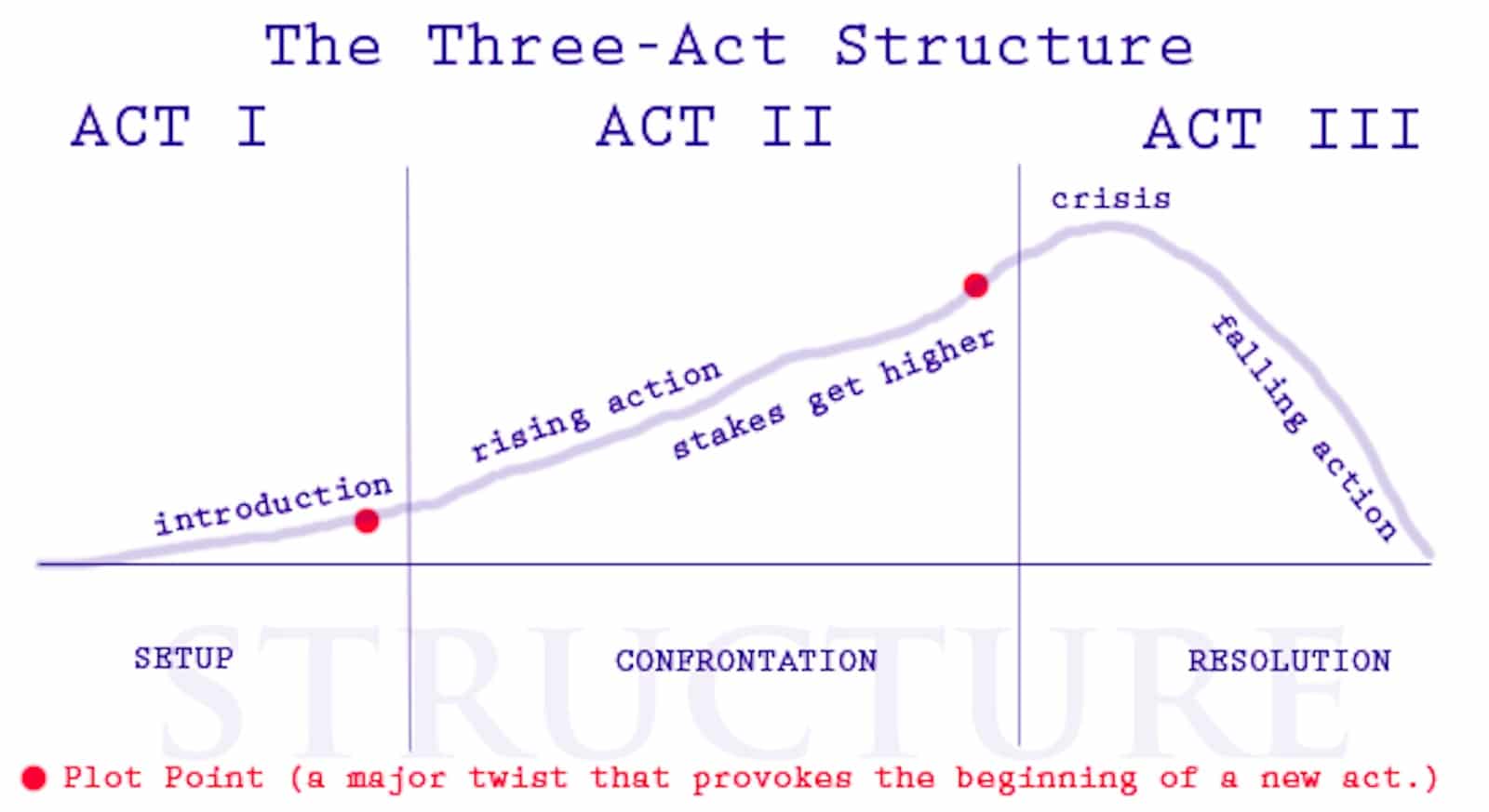
The Three-Act Structure
The three-act structure is a model that divides a narrative into three parts, often referred to as the Setup, Confrontation, and Resolution. This approach to storytelling, which is rooted in classical drama, helps to organize a narrative by establishing a clear beginning, middle, and end.
Act One (Setup) introduces the main characters, their world, and the central conflict or goal.
Act Two (Confrontation) escalates the conflict and complications, often leading to a critical turning point.
Act Three (Resolution) resolves the conflict, providing closure to the story's events.
This structure is widely used in screenwriting and is beneficial for creating a cohesive and engaging story by ensuring that each part of the narrative contributes to the overall progression and climax. Some screenwriters adhere strictly to this model, while others adapt its basic principles to fit more complex or unconventional narratives.
The Three-Act Structure
The three-act structure is a common narrative framework used in various forms of storytelling, including films, plays, novels, and more. This structure is considered effective because it provides logical progression and coherence to the story, guiding the audience from the beginning through the climax to the resolution.
Act One (Setup):
- Introduces the background environment and main characters of the story, allowing the audience to understand the story world and character motivations.
- Establishes the main conflict or problem, laying the foundation for subsequent developments.
- Sets up the goals and desires of the main characters, along with potential obstacles or challenges, providing momentum and motivation for the story.
Act Two (Confrontation):
- In Act Two, the story unfolds gradually, with the main conflict deepening and developing.
- Audiences witness the main characters facing a series of challenges and obstacles as they strive to achieve their goals.
- Act Two is typically the longest and most complex part of the story, encompassing various plot developments and interactions between characters.
Act Three (Resolution):
- Reaches the climax of the story, where the main conflict is resolved or reaches its peak.
- Audiences see the transformation and growth of the main characters during the climax, as well as how they confront the final challenge.
- The story is resolved in Act Three, usually providing a clear ending or resolution that gives the audience a sense of closure.
Through this structure, the story can develop with peaks and valleys, keeping the audience engaged, and ultimately providing them with a meaningful storytelling experience.
Week 3 asynchronous class Quiz result:
Week 4
Film Production Breakdown
Development:This phase is the inception of a film. It starts with an idea from a producer or screenwriter, who then works to transform that idea into a feasible movie project. The producer typically oversees development, handling the initial creative direction, securing financing, and setting an overall timeline.
Pre-production:This stage involves all necessary preparations before filming begins. Key activities include:
Budgeting:The producer develops a detailed shooting schedule and budget, accounting for locations, cast, crew, and equipment.
Assembling the Team:The producer, with input from the director, hires department heads like cinematographers, production designers, and costume designers. The casting director reads the script, consults with the director, and auditions actors for all roles.
Pre-visualization:The director and director of photography plan the film's visual style, creating storyboards or shot lists. They collaborate with the production designer on set aesthetics and with the costume designer on costumes. Location scouting is accompanied by a technical scout to address logistical concerns such as transportation, power, sound, and natural lighting.
Once pre-production planning is sufficiently detailed, filming can commence.
Production:This is the phase where all prior planning is executed. Key steps during a shoot include:
1. The assistant director (AD) announces "Picture is up."
2. The AD calls for quiet, then instructs "Roll sound," prompting the sound mixer to start recording and respond with "Speed of sound."
3. The AD says "Roll camera," and the camera operator begins filming, confirming with "Speed."
4. The clapper loader marks the scene information on the clapper board.
5. The director calls "Action" to start the scene and "Cut" to end it.
Post-production:This stage involves several crucial processes beyond just editing the film.
Picture Editing:The editor, working with the director, cuts the footage to create a coherent narrative. This process involves three main edits: the initial assembly, the rough cut focusing on pacing, and the fine cut leading to picture lock.
Sound Editing:This includes placing sound effects, dialogue, and voiceovers in the correct spots, followed by sound mixing to balance audio levels for various playback environments.
Visual Effects:Many shots undergo additional processing with visual effects, including CGI for tasks ranging from removing unwanted objects to creating complex imagery.
Color Grading:A colorist adjusts the film's colors, which varies based on how the film was shot (e.g., on film or digitally in RAW format).
Distribution:This phase covers the wide range of tasks involved in getting the film to audiences. Marketing plays a significant role here, as effective promotion is essential to attract viewers. The strategies used vary greatly depending on the film's budget and expected box office performance.
Week 4 asynchronous class Quiz result:
Editing Exercise
week1
Arrange video clips in Adobe Premiere Pro
In the first week, we got a basic introduction to Adobe Premiere Pro. Our exercise is to arrange the provided video clips in the correct order.
Fig 1.1 Organizing Mints Advertising Video Clips, Week 1
The first set of video clips are Mints ads, they are numbered in a corresponding order, just arrange them in order.
The second set of video clips are from Doritos commercials, but they are not numbered sequentially, so we have to watch each clip to figure out the order and put them in order.
Fig 1.3 Organizing “Doritos”Advertising Video Clips, Week 1
"The Little Priest and the Old Nun" is a Russian stop-motion animation that may be beloved for several reasons:
Artistic Style: The unique visual style of stop-motion animation offers a viewing experience distinct from traditional animation, with high artistic value and creative expression.
Plot and Characters: The characters and plot in the animation often possess depth, eliciting emotional resonance from viewers and fostering strong interest in the story's development.
Cultural Elements: As a product of Russian production, it incorporates local cultural characteristics. This uniqueness in culture may attract audiences interested in Russian culture and provide them with a means to understand and experience it.
From the title, "The Brown Forest" likely depicts a natural scene filled with brown tones. Such a choice of colors may create a warm and mysterious atmosphere, attracting audiences seeking a non-typical visual style. Additionally, the themes and narrative of the animation are essential factors in drawing in viewers. If this short film explores significant topics such as environmental protection or the relationship between nature and humanity, or if it uses the forest as a metaphor to convey profound life or societal meanings, then its thematic depth may also be a crucial reason for audience appreciation. Lastly, music and sound effects play vital roles in stop-motion animation. Appropriate music and sound design can enhance the emotional depth of the story, making the animation more vivid and captivating.
Innovative Artistic Expression: If the animation adopts Van Gogh's unique style, characterized by vibrant colors and dynamic brushstrokes, it alone is enough to attract audiences. Stop-motion animation can vividly showcase this style, resurrecting Van Gogh's art in a new form.
Narrative Storytelling: If the animation focuses on Van Gogh's life, works, or specific events (like a dinner with friends), it may explore his personal life, artistic journey, or relationships. This deep storytelling can resonate with viewers, especially those familiar with Van Gogh.
Emotional Connection: Van Gogh's life and works are often linked to profound emotions and psychological states. Through animation, his emotional world can be delicately and touchingly portrayed, allowing viewers to experience his inner world.
Technical Mastery: Stop-motion animation requires high technical precision and creativity. Each frame's design and filming demand meticulous planning and execution, constituting an art form in itself. Appreciation for technical craftsmanship may also contribute to audience enjoyment.
Week 2
Shooting Editing Exercise: Framing and Editing Exercise: Adding Titles
Premiere Pro Editing Exercise 1
Shooting Practice: Framing
We were put into pairs to do the framing exercises.
Fig 2.1 Timeline Panel - Editing and Adding Subtitles
Clip Trimming: Adjust the duration of each clip as required.
Sequencing Shots: Incorporate the trimmed clips into the sequence in alignment with the provided shot list.
Title Integration and Transition Enhancement: Integrate titles for each clip and enhance transitions using cross-dissolve effects for seamless transitions.
Background Music Inclusion: Introduce background music to enrich the audiovisual experience and set the tone for the video.
"Lalin" requires us to edit a 35-second video based on the original video provided to tell Lalin’s story. You need to select the right shots from the original footage, edit them in the order of the storyline, and ensure smooth transitions in the video. Finally, add background music or sound effects, make final adjustments, and export.
Video 4: Original Video - Lalin
Fig 2.3 Editing video clip to 35 seconds
Final cut video:
Final result of Premiere Pro Editing Exercise 1 “Lalin”
We will analyze two short films based on a three-act structure by filling out the worksheet provided by Mr. Martin.
1. Larin
1. What are the first, second and third acts?
Describe each behavior in just one paragraph.In Act One, the protagonist introduces herself and showcases her online relationship with a netizen named Nuts. Specifically in Plot One, Nuts suddenly proposes a face-to-face meeting, triggering inner turmoil and unease within the protagonist.
Act Two delves into Nuts' situation in Japan and includes some flashback scenes. Meanwhile, in Plot Two, the protagonist explores Nuts' confession folder, adding complexity and drama to their relationship dynamics.
The third act presents the resolution where the anticipated real-life encounter between the two ultimately does not materialize, leaving viewers with varying degrees of introspection and emotional resonance.
2. What is the inciting incident in the movie?
The inciting incident of the movie is Nuts' sudden request for a face-to-face meeting with the protagonist, which profoundly impacts her due to her insecurity about her appearance, leading to inner turmoil and conflict.
3. What is the midpoint scene in the movie?
The midpoint scene occurs when the protagonist is forced to confront her inner fears, bravely revealing her true face and seeking liberation and self-acceptance amidst inner struggles.
4. What is the climactic scene in the movie?
The climactic scene unfolds as the protagonist chooses to evade meeting Nuts, a decision that later fills her with profound regret and guilt, bringing about a dramatic turning point in the story.
5. What is the theme of this movie?
The movie explores a range of profound themes including identity, self-acceptance, and the influence of social media on shaping perceptions and self-worth in contemporary society.
Thai short film - Lalin :
2. Everything, everywhere, all at once.
1. What are the first, second and third acts?
Describe each behavior in just one paragraph.The first act introduces the protagonist Evelyn and her strained relationship with her family, particularly the generational conflict with her daughter. Episode 1 depicts Evelyn's adjustment to the multiverse after transitioning, and her initial assimilation into this new reality. The second act delves into Evelyn's exploration of the multiverse, as she grapples with challenges and undergoes personal transformations while traversing various worlds. Episode Two highlights Evelyn's confrontations with her daughter across different dimensions, prompting profound introspection. The third act resolves Evelyn's conflicts with Job Tupaki and her daughter, leading to a mutual understanding that resolves the emotional turmoil.
2. What is the inciting incident in the movie?
The inciting incident of the movie occurs when Evelyn's multiverse husband contacts her unexpectedly, revealing that she holds the key to saving the entire multiverse. This revelation propels Evelyn into a series of adventures across different universes, where she encounters numerous obstacles.
3. What is the midpoint scene in the movie?
The midpoint scene in the movie occurs when Evelyn explores diverse worlds and contemplates alternate versions of her life, challenging her perspectives and beliefs. This pivotal moment prompts significant self-reflection and growth as she navigates her journey through the multiverse.
4. What is the Climax scene in the movie?
The climactic scene unfolds as Evelyn confronts the culmination of conflicts within the multiverse, her family dynamics, and her alter ego, Job Tupaki. This intense showdown pits Evelyn against her alter egos across various realms, resulting in a fierce battle that resolves pivotal storylines.
5.What is the theme of the movie?
The theme of the movie underscores the significance of love and family bonds, as well as the sacrifices made to protect and nurture familial relationships. Evelyn's odyssey across multiple universes serves as a testament to her unwavering dedication to her family, wherein she confronts inner struggles and makes challenging decisions to safeguard their well-being. Through her journey, she reaffirms the enduring power of love and the lengths one is willing to go for the sake of family unity.
REFLECTION
WEEK 1:
This week, I learned how to use Adobe Premiere Pro to edit videos. I explored various features such as cutting, trimming, and applying transitions, which are essential for creating smooth and professional-looking video content. Additionally, I delved into the concepts of lens language and lens size during shooting. Understanding these elements has given me a clearer perspective on how different shots and angles can convey specific emotions and narratives, helping me better interpret the director's vision and intention.
WEEK 2:
This week, I studied the three-act story structure, a fundamental framework in film and literature. The three acts consist of the beginning, confrontation, and ending. I learned that the beginning establishes the characters and sets up the story. The confrontation serves as the climax, where the main conflict reaches its peak. The ending resolves the story, providing closure—whether it's a happy, sad, or ambiguous conclusion that leaves the audience guessing. Understanding this structure has enhanced my appreciation of storytelling and narrative flow in films.
WEEK 3:
This week, I continued to explore the three-act story structure, reinforcing my understanding of its importance in crafting compelling narratives. I also delved into scriptwriting, which is a crucial phase in the early stages of film and animation production. Scriptwriting involves creating dialogue, setting scenes, and developing the plot, all of which are vital for bringing a story to life. Learning about scriptwriting has provided me with insights into how stories are constructed from the ground up, emphasizing the importance of planning and detail in successful storytelling.
02/02/2026 - 29/03/2026 (Week 01 - Week 08) Wang Yifan / 0368363 Major Project 2 / Bachelor's of Design Honors In Creative Media Final Compilation and Reflection INTRODUCTION Proposal Deck Storyboard Major Project 1 schedule : https://drive.google.com/drive/folders/1wgi5UITNIXRNbIZMmqYyhQftcb2yBs-z?usp=drive_link WEEKLY PROCESS Week 01 In this project Spark of Hope , My main responsibilities are character design and 2D animation. The story follows Miles, a firefighter who lost his parents in a fire during childhood, leaving him with deep fear and trauma. With the encouragement of a senior firefighter, he grows into a firefighter himself. During a rescue mission, he is forced to face his past again and eventually overcomes his fear while saving others. The story focuses on the theme of overcoming trauma and finding strength. Logline recap For character design, I started working in Procreate. In Week 1, I was mainly spent completing the basic line art for the othe...
-SPETEMBER 24, 2024 24/09/2024 - //2024 (Week 02 – Week 06) Wang Yifan / 0368363 Film Studies and Cinematography / Bachelor of Design (Honours) in Creative Media / Taylors University Project 1 – Story Development
21/04/2025 - 18/05/2024 (Week 01 – Week 04) Wang Yifan / 0368363 Montion Graphics & Compositing / Bachelor of Design (Honours) in Creative Media / Taylors University Project 3: Channel Identity INTRODUCTION Project 3: Channel Identity For Project 3, it is a continuation of our previous Project 2, where we designed a channel bumper. In this task, we are required to create a 15–30 second Channel Ident motion graphic video for the same channel brand we developed earlier—whether it is an existing or fictional one. This video should showcase the visual style and brand identity of the channel through motion graphics. We are also allowed to reuse and build upon the visual elements from the previous project to maintain consistency in branding. Mood board This moodboard was created to reflect the soft, dreamy, and childlike feeling I wanted for my Jellycat channel ident. I included a variety of Jellycat plush toys like bunnies, bears, and seagulls to bring a sense of warmth and life int...




评论
发表评论